
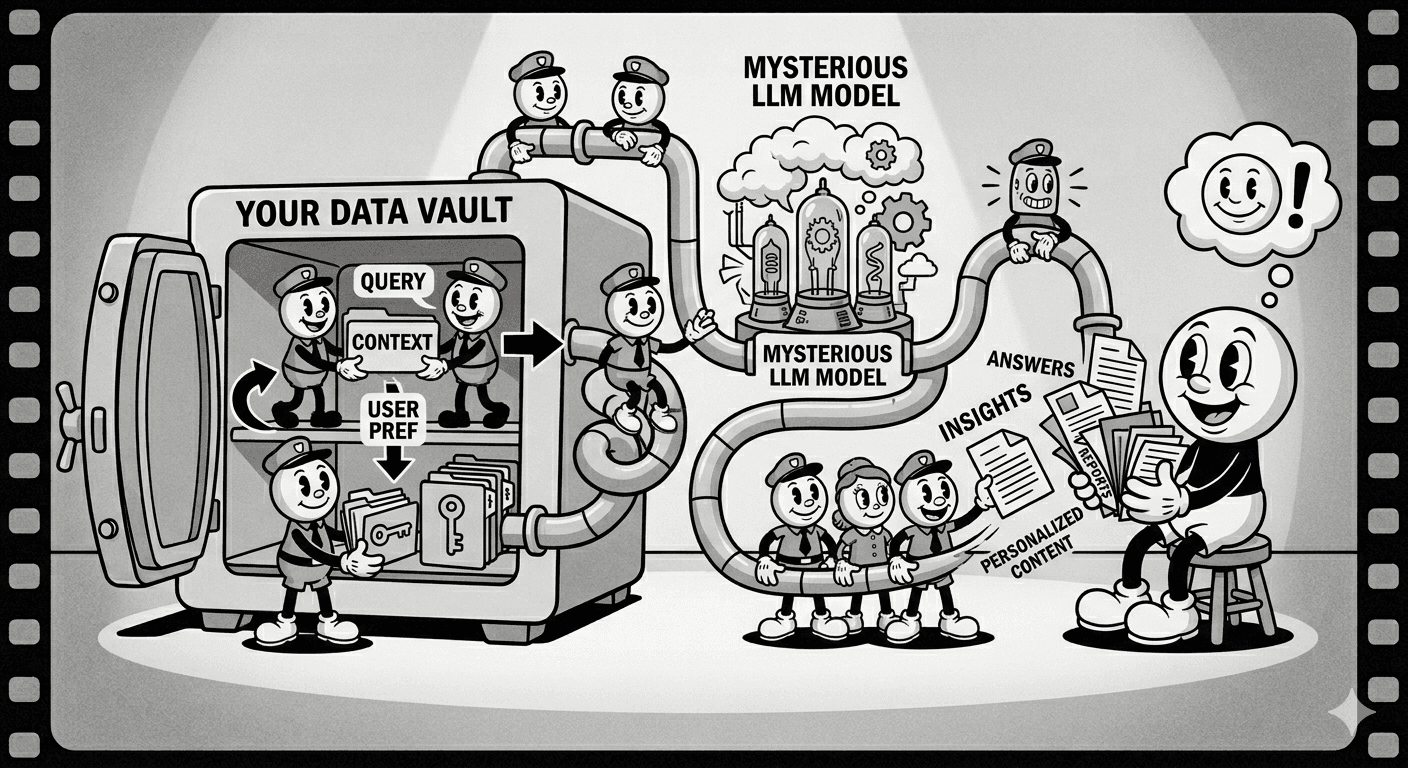
It is easy to mistake the chat window for the whole product. Drop a document in, ask a question, get an answer — the experience is so close to magical that the architecture underneath stops feeling like a decision. For an individual user, it is not. For an enterprise, it is the most consequential decision in the stack. The gap between "use the model directly" and "use a private AI built around the model" looks small from a demo and turns out to be load-bearing in production.
You should be able to run any model you like
Foundation models are not a static category. The leader at one task in January is rarely the leader at the same task in June. Reasoning, summarization, code, multilingual extraction — each capability has its own ranking, and those rankings churn faster than most enterprise procurement cycles can keep up with. A platform built directly against one model is a platform that has bet its roadmap on a single vendor's release calendar. A private AI treats the model as a component: swap it when something better arrives, route different tasks to different models, and keep the rest of the system — your data, your retrieval layer, your access controls, your evaluation harness — exactly where it was.
Model lock-in is a slow leak. By the time it is obvious, the platform has been built against assumptions that no longer hold.
The economics of retrieval
When a user uploads a document straight into a chat, the entire document goes into the model's context window every time the user asks a question about it. That is the default behaviour, and at enterprise scale it is also the default cost. A retrieval-augmented architecture changes the economics: the document is chunked and indexed once, and from that point forward only the snippets relevant to a given question are sent to the model. The model sees a paragraph, not a 400-page CIM. The token bill follows accordingly — often by an order of magnitude or more across a year of real usage.
The same architecture changes what is even possible to ask. Foundation models impose hard limits on the size of a single input. Retrieval has no equivalent ceiling. A whole data room — thousands of files, gigabytes of text — can sit behind a single conversation, and every question pulls from the right place in the corpus without ever pretending the model has read it all. The user experience converges on "ask any question of any document"; the engineering reality is that the model never has to hold the whole library in its head.
Permissioning, compliance, and audit
The most underestimated reason enterprises move to a private AI is that direct chat has no idea who the user is. If User A is allowed to see Document X but not Document Y, a public model uploaded to has no mechanism to enforce that — the document is in the context window or it is not, and that decision sits with whoever did the upload. A private RAG system filters at retrieval time: the same query from two different users returns different sources, scoped to what each is permitted to see. That is a control the compliance team can describe, test, and sign off on. The chat-window equivalent is a policy memo and a hope.
The same posture applies to audit. Every retrieval, every prompt, every response is logged with the user, the documents touched, and the timestamp. When a regulator, a counterparty, or an internal review asks "what did this system tell whom and why," the answer is a query, not a reconstruction. Direct model usage produces no equivalent record by default — and adding one after the fact is a much harder retrofit than building it in.
The shape of the decision
None of this argues against the foundation models. The opposite — a private AI is the layer that lets an enterprise actually use them, at the scale and under the controls the business requires. Model choice, token economics, unlimited document scale, and enforceable permissioning are not four features. They are four expressions of the same underlying architectural decision: keep the data, the access controls, and the orchestration inside the firm, and let the model be a component you can replace. The firms that get this right stop having an AI strategy within a year. They have a platform, and the model is just the part of it that changes most often.